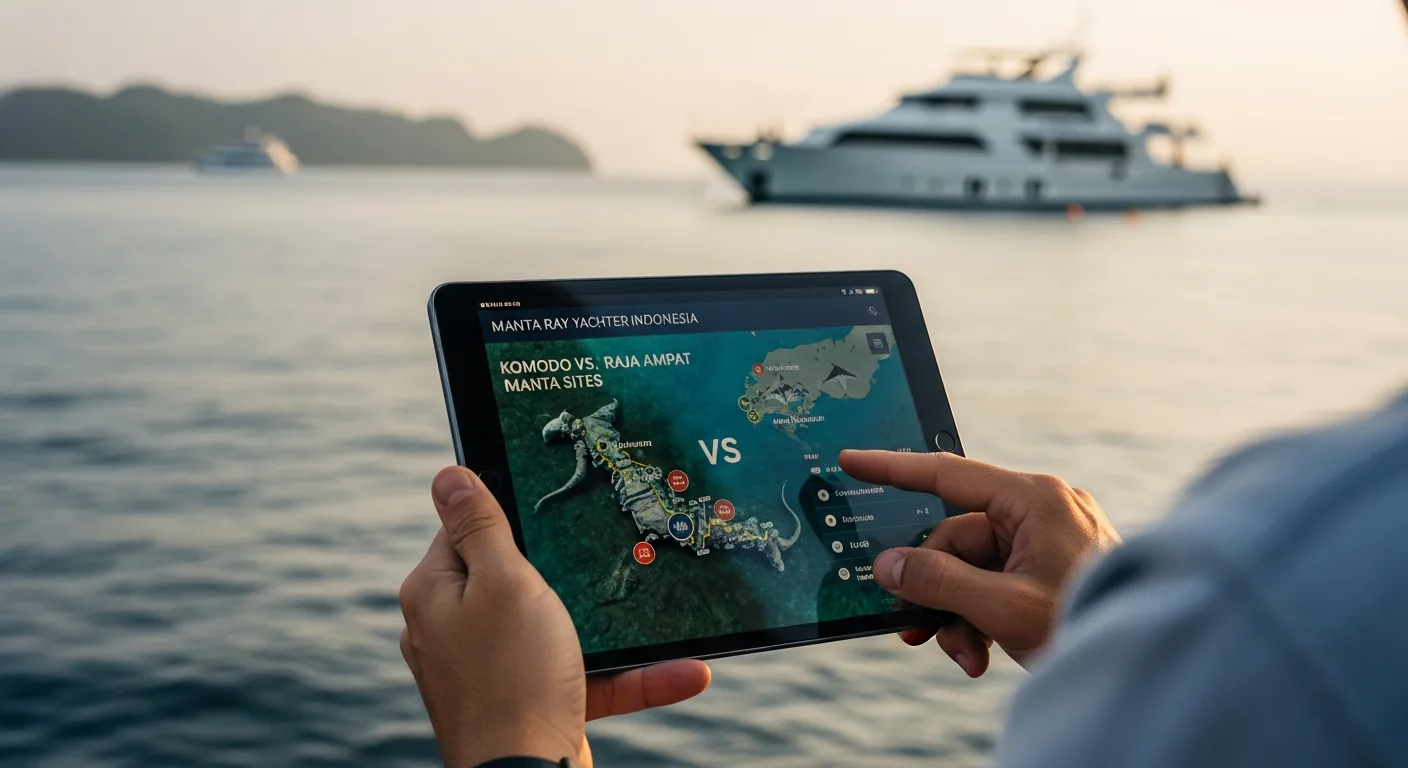
Komodo vs Raja Ampat for Mantas: A Definitive Comparison for Your Manta Ray Yacht Charter
The silence is the first thing you register. Suspended in a column of blue, the only sound is the slow cadence of your own breathing. Then, a shadow detaches from the periphery. It is not a fleeting shape but a presence, a form of impossible grace that resolves into a giant. A manta ray, with a wingspan of four meters, glides effortlessly toward you, its cephalic fins curled in gentle curiosity. It is an encounter that reorders your perception of the ocean. It is the reason you are here. See also: Manta Ray Yacht Charter Indonesia.
For the discerning diver and marine wildlife connoisseur, the question is not whether to seek this experience, but where. Indonesia’s Coral Triangle is the global epicenter of marine biodiversity, and within it, two locations present the most compelling opportunities for manta ray congregations: Komodo National Park and Raja Ampat. Choosing between them is a critical decision in planning a private manta yacht in Indonesia. The answer depends on a nuanced understanding of seasonality, species, environment, and your personal definition of a perfect marine encounter. This is not a choice between good and better, but a selection between two distinct, world-altering experiences. See also: book Contact.
The Manta Ray Encounter: A Tale of Two Archipelagos
At the heart of the decision is the nature of the mantas themselves. Indonesia is host to both of the planet’s manta ray species: the Reef Manta (*Mobula alfredi*) and the larger, more pelagic Oceanic Manta (*Mobula birostris*). While their ranges can overlap, one species tends to dominate in each location, shaping the character of the dives. A manta cruise in Komodo offers a fundamentally different context than a manta cruise in Raja Ampat. Komodo is a theater of powerful currents and predictable aggregations, while Raja Ampat provides a more varied backdrop, from serene cleaning stations to deep-water channels where giants may appear. Understanding these differences is the first step in crafting a charter that aligns with your specific photographic, scientific, or experiential objectives. The topography, water temperature, and prevailing marine conditions in each region dictate not only which mantas you will see, but how you will see them. See also: Manta Ray Yacht Charter Indonesia.
Komodo National Park: The Realm of Reef Mantas
Komodo National Park, a UNESCO World Heritage site established in 1980, is an archaic landscape of saw-toothed volcanic islands and sun-scorched savannah. Below the surface, its character is defined by the Indonesian Throughflow, a massive volume of water moving from the Pacific to the Indian Ocean. This exchange creates a volatile and nutrient-rich environment, with currents that can exceed six knots. This is the engine that drives Komodo’s marine ecosystem and creates a reliable haven for large populations of Reef Mantas (*Mobula alfredi*). See also: Manta Season Best Time pricing.
The encounters here are often high-energy. The primary site, Karang Makassar (often called Manta Point), is a vast, shallow rubble field approximately 1.5 kilometers long, swept by consistent currents. Divers drift over the bottom, watching as dozens of mantas—sometimes more than 40 individuals in a single dive—hover over coral bommies, using them as cleaning stations. These are service appointments with cleaner wrasse, and the mantas queue, circle, and interact in a social display that provides extended, predictable viewing. Komodo’s currents act as a conveyor belt for plankton, creating a reliable food source that supports a significant resident manta population. The consistency of sightings at established cleaning stations like Karang Makassar makes it an important global site for manta research and tourism.
The optimal season for a manta dive charter in Komodo is during the dry season, from April through November. During this period, water clarity is generally excellent (15-30 meters) and surface conditions are calm. Water temperatures average 26 to 29°C. While mantas are present year-round, these months offer the most comfortable and consistent conditions for a private yacht expedition.
- Primary Species: Reef Manta (*Mobula alfredi*), with wingspans typically 3-5 meters.
- Key Sites: Karang Makassar (Manta Point), The Cauldron (Shotgun), Batu Bolong.
- Encounter Type: High-density aggregations at cleaning stations and feeding in strong currents.
- Topography: Volcanic islands, sloping reefs, rubble fields, and high-voltage channels.
Raja Ampat: Oceanic Giants and Diverse Habitats
Raja Ampat, an archipelago of over 1,500 jungle-clad limestone islands off the coast of West Papua, is a different marine universe. Its biodiversity is legendary, holding the record for the most fish species (1,508) recorded on a single reef. This sheer biological wealth creates a complex and varied environment for manta encounters. Unlike Komodo’s focused intensity, Raja Ampat offers a wider portfolio of experiences, including the rare opportunity to encounter both Reef and Oceanic Mantas.
The key differentiator is the presence of the Oceanic Manta (*Mobula birostris*), a true giant of the seas with a wingspan that can reach seven meters. While not as numerous as Komodo’s reef mantas, the sight of an oceanic manta emerging from the deep blue is a profound experience. Sites like Blue Magic and Manta Ridge are seamounts exposed to open-ocean currents, attracting these pelagic visitors. Here, the encounters are less about dense aggregations and more about the awe of a singular, massive animal.
Reef Mantas are also abundant. Manta Sandy is a world-renowned cleaning station set in a shallow, sandy amphitheater. Here, in calmer conditions than Komodo, divers can position themselves on the sand and watch as up to 20 reef mantas gracefully circle several large coral heads for cleaning. According to Marcus Chen, a lead conservationist with a decade of experience in Raja Ampat, “The variety of habitats in Raja Ampat, from the mangrove-fringed bays of Gam to the exposed pinnacles of the Dampier Strait, allows mantas to fulfill different life-cycle needs in a relatively small area. This gives charter guests a chance to observe different behaviors, from cleaning and courtship to feeding.” The primary season for a manta yacht charter in Raja Ampat is from October to April, when seas are calmest. Water temperatures are a consistent 28-30°C.
- Primary Species: Reef Manta (*Mobula alfredi*) and Oceanic Manta (*Mobula birostris*).
- Key Sites: Manta Sandy, Manta Ridge, Blue Magic, Eagle Rock.
- Encounter Type: Both cleaning station aggregations and pelagic encounters with larger oceanic individuals.
- Topography: Limestone karsts, deep channels, seamounts, pristine hard and soft coral gardens.
A Comparative Analysis: Key Metrics for Your Decision
To assist in your planning, this table provides a direct comparison of the critical factors that will influence your private charter experience. Evaluate these metrics against your personal priorities—be it photography, species diversity, or the thrill of challenging dive conditions.
| Feature | Komodo National Park | Raja Ampat |
|---|---|---|
| Manta Species | Predominantly Reef Mantas (*M. alfredi*). High numbers. | Both Reef Mantas (*M. alfredi*) and larger Oceanic Mantas (*M. birostris*). |
| Peak Manta Season | April to November (Dry Season) | October to April (Northwest Monsoon) |
| Water Temperature | 26-29°C, with cooler upwellings possible in the south. | Consistently warm, 28-30°C. |
| Currents | Often strong to very strong (2-6+ knots). Advanced drift diving skills required. | Variable, from mild to strong. More sites with calmer conditions available. |
| Topography & Scenery | Dry, volcanic islands. Underwater, vibrant reefs and rubble channels. | Lush, jungle-covered limestone karsts. Unmatched coral garden diversity. |
| Other Key Wildlife | Komodo dragons, sharks, eagle rays, exceptional macro life. | Wobbegong & walking sharks, massive fish schools, pristine corals, birds of paradise. |
| Accessibility | Fly to Labuan Bajo (LBJ) from Bali (DPS) or Jakarta (CGK). Multiple daily flights. | Fly to Sorong (SOQ), typically via Jakarta (CGK), Makassar (UPG), or Manado (MDC). |
Charter Costs and Logistics: A Financial Framework
A private manta ray yacht charter represents a significant investment in a bespoke experience. The financial outlay differs between Komodo and Raja Ampat, driven primarily by logistics and operational seasonality. A fully-crewed private charter in Indonesia typically ranges from $650 to over $1,100 USD per person, per night, depending on the vessel’s size, amenities, and the number of guests. Our fleet offers several options to suit different group sizes and levels of luxury.
Beyond the charter fee, several other costs require consideration:
- Park & Port Fees: Komodo National Park fees are approximately $25-$35 USD per person, per day. The Raja Ampat Marine Park fee is a one-time payment of IDR 1,000,000 (approx. $65 USD) valid for one year.
- Domestic Flights: Flights to Labuan Bajo (LBJ) for Komodo are generally more frequent and less expensive than flights to Sorong (SOQ) for Raja Ampat. Budget between $150-$300 USD for round-trip flights from Bali to Labuan Bajo, and $400-$700 USD from Jakarta to Sorong.
- Equipment Rental: While our charters include tanks and weights, specialized gear or full equipment sets may incur an additional daily charge of $30-$50 USD.
- Gratuities: A gratuity of 5-10% of the charter fee is customary for the crew and is greatly appreciated for exceptional service.
Raja Ampat’s remoteness contributes to slightly higher operational costs, which can be reflected in charter pricing. However, its longer valid park permit can offer better value for extended trips compared to Komodo’s daily fee structure.
Beyond the Mantas: The Supporting Cast of Marine Life
While mantas are the headline act, the full cast of marine characters in each location is a vital part of the narrative. A manta cruise in Komodo is an exploration of contrast. After a dive with graceful rays, you can go ashore on Rinca or Komodo Island to witness the primal power of the Komodo dragon, the world’s largest lizard. The park’s macro life is also exceptional, with sites like Siaba Besar offering ghost pipefish, frogfish, and a multitude of rare nudibranchs.
Raja Ampat, by contrast, is a study in overwhelming abundance. The reefs of Misool in the south are considered by many marine biologists to be among the most vibrant on Earth, a kaleidoscope of soft corals and sea fans teeming with anthias. It is here you find endemic species like the Papuan epaulette (walking) shark, which literally walks across the reef on its pectoral fins. The Dampier Strait is famous for its “fish tornados”—vortexes of schooling barracuda, jacks, and fusiliers so dense they can block out the sun. For the underwater photographer, Raja Ampat presents an almost inexhaustible canvas of subjects beyond its manta population.
Your Bespoke Manta Cruise: Crafting the Itinerary
The final decision rests on your priorities. Are you a photographer seeking dozens of reef mantas in clear, current-swept conditions? Komodo is your likely answer. Are you a seasoned explorer captivated by the idea of encountering a seven-meter oceanic giant and exploring the world’s most biodiverse reefs? Raja Ampat calls. With Manta Ray Yacht Charter Indonesia, your expedition is not a pre-packaged tour but a collaborative creation. Our specialists work with you to align the destination, vessel, and season with your specific vision.
To begin the process, consider these action items:
- Define Your Manta Priority: Is your goal to see the highest number of mantas possible, or is it to see the largest species and the greatest variety of marine life?
- Select Your Season: The opposing seasons of Komodo (April-Nov) and Raja Ampat (Oct-April) make this a primary decision point. Your travel window will heavily influence the destination.
- Assess Diver Experience: Be realistic about your and your group’s comfort level. Komodo’s currents demand confident, experienced divers. Raja Ampat offers more flexibility for varied skill levels.
- Consult with Our Charter Specialists: The most critical step is a conversation. Our team possesses intimate, firsthand knowledge of these waters and can provide insights that go far beyond any guide.
Whether you choose the primal energy of Komodo or the kaleidoscopic abundance of Raja Ampat, a private yacht charter is the only way to fully access these remote and protected sanctuaries. It provides the flexibility to follow the wildlife, the comfort to reflect on each day’s encounters, and the exclusivity to experience these natural wonders on your own terms.
Contact Our Charter Specialists to Plan Your Expedition
Discuss your objectives with our experts to design a private manta ray charter tailored to your specific interests in Komodo or Raja Ampat.
Manta Ray Yacht Charter Indonesia
Phone: +62 811-3823-875
Email: [email protected]
Office: Jalan Sunset Road No. 88, Kuta, Badung, Bali 80361, Indonesia